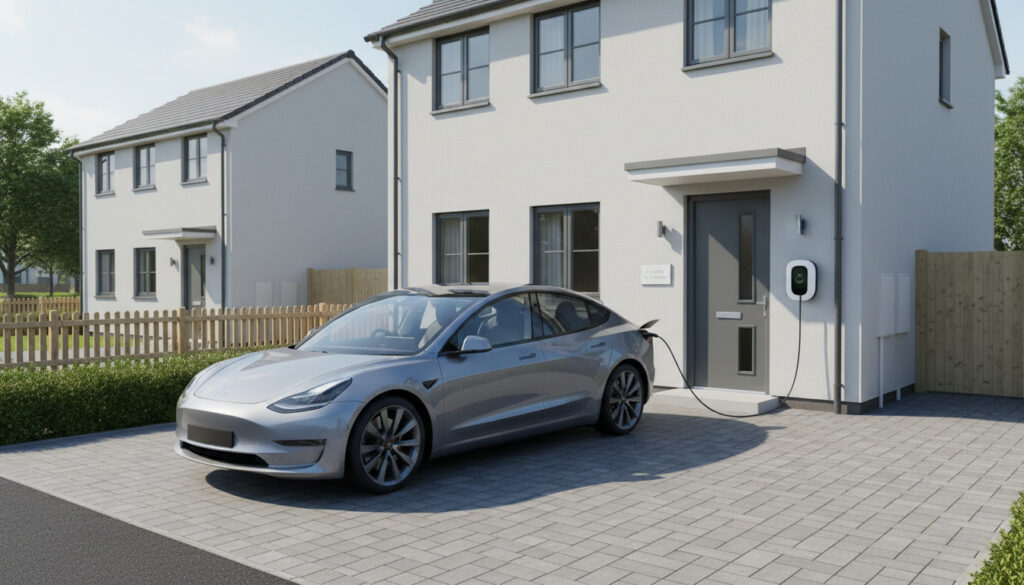
UK EV Driveway Charge – 2025 Planning Rules Guide
New regulations governing electric vehicle charger installations on residential driveways came into force across England on 29 May 2025, fundamentally altering the planning landscape for homeowners. The amendments to permitted development rights mean that most small domestic EV charging units no longer require planning permission when installed on private off-street parking, removing a significant bureaucratic barrier that previously delayed adoption.
The changes, enacted through the Town and Country Planning (General Permitted Development) (England) Order, eliminate the former requirement that chargers maintain a minimum two-metre distance from the highway. While England has relaxed these constraints, Wales maintains stricter regulations, and certain property types remain excluded from the streamlined process.
Do I Need Planning Permission for an EV Charger on My Driveway?
What Changed
Permitted development rights now cover most small domestic EV chargers on private driveways in England.
Who Benefits
Homeowners with off-street parking on freehold properties outside sensitive designated areas.
Effective Date
29 May 2025 for England; Wales maintains different rules as of 31 August 2025.
Key Limit
Charging units must not exceed 0.2 cubic metres in total volume.
- England removed the previous two-metre highway distance restriction for driveway chargers.
- Wales continues to require planning permission for chargers positioned within two metres of a highway.
- Listed buildings, scheduled monuments, and conservation areas remain excluded from permitted development rights.
- Leasehold properties and shared driveways do not qualify for the streamlined process.
- Installation must comply with BS 7671 electrical standards using an OZEV-authorised installer.
- Building Regulation Part S applies only to new-build infrastructure, not retrofit installations.
- Obtaining a Lawful Development Certificate provides formal proof of compliance despite not being mandatory.
| Regulatory Aspect | Specification |
|---|---|
| Effective Date (England) | 29 May 2025 |
| Legal Instrument | Town and Country Planning (General Permitted Development) (England) Order amendments |
| Maximum Unit Size | 0.2 cubic metres |
| Location Requirement | Private driveway or off-street parking |
| Highway Distance Rule (England) | Removed (no minimum distance required) |
| Highway Distance Rule (Wales) | Retained (within 2m requires permission) |
| Excluded Properties | Listed buildings, scheduled monuments, conservation areas, leasehold, shared driveways |
| Electrical Standard | BS 7671, IET Wiring Code |
| Installer Requirement | OZEV-authorised |
| Building Regulations | Part S (new builds only) |
Detailed specifications for England are available through planning guidance resources and building solutions documentation.
What is the UK EV Driveway Charge?
Despite widespread search queries referring to a “UK EV driveway charge,” no such financial levy currently exists for residential EV charger installations. The phrase has emerged from public confusion surrounding the 2025 planning regulation changes, which alter the permissions required for installation rather than imposing a tax or fee on driveway charging itself.
Distinguishing Planning Permission from Financial Levies
The term “charge” in this context relates to the regulatory requirements—the “charge” being the responsibility to obtain planning permission—rather than a monetary cost levied against homeowners. Government announcements and planning documents contain no evidence of an Angela Rayner-associated levy, specific tax exemptions, or a dedicated “right to repair fund” for EV chargers within these regulations.
Current regulations contain no financial levy specifically targeting driveway EV chargers. The “charge” referenced in public queries pertains to planning permission responsibilities, not monetary taxation. Government sources confirm that the 29 May 2025 changes concern permitted development rights exclusively.
What Qualifies as Permitted Development
Under the amended rules, permitted development applies to wall-mounted or freestanding charging units provided they occupy no more than 0.2 cubic metres and sit on private driveways or off-street parking areas. This classification removes the necessity for a full planning application, reducing administrative timelines from several months to days or weeks.
To qualify, installations must be on private off-street parking, not opposite pavement areas. Units must not exceed 0.2 cubic metres. Always verify that no restrictive covenants affect your property, as these override permitted development rights regardless of the new regulations.
When Full Permission Remains Necessary
Sensitive sites retain pre-existing safeguards. Properties within conservation areas, listed buildings, scheduled monuments, and leasehold estates still require formal planning permission. Shared driveways and properties subject to restrictive covenants fall outside the scope of the new permitted development rights, necessitating individual assessment by local authorities.
Listed buildings, conservation areas, and scheduled monuments remain excluded from the 2025 permitted development relaxation. Leasehold properties and shared driveways similarly require planning permission. Always consult your local planning authority for borderline cases or apply for a Lawful Development Certificate to confirm compliance.
Technical specifications regarding unit classifications are detailed by industry manufacturers tracking regulatory updates.
How Much Does the EV Driveway Charge Cost?
The elimination of planning permission requirements for qualifying installations removes approximately £250 in application fees and months of administrative waiting periods. Homeowners now face only the direct costs of equipment purchase and professional installation, significantly reducing the financial barrier to EV adoption.
Planning Fee Savings
Prior to 29 May 2025, applicants paid planning fees and endured protracted review timelines. The new permitted development status removes these costs entirely for standard installations, compressing the project timeline from months to days or weeks.
Installation and Compliance Expenses
Installation costs vary by electrician and property-specific electrical requirements. OZEV-authorised installers must verify compliance with BS 7671 standards, including RCD or RCBO protection. While the E-on Next sustainable energy transition continues across the UK, homeowners should budget for qualified professional fees and any necessary electrical upgrades.
Available Incentives
The Office for Zero Emission Vehicles maintains grant schemes for eligible installations, though specific grant amounts and eligibility criteria require verification through current government portals. Combining charger installation with driveway resurfacing or electrical upgrades may improve overall cost efficiency.
When Do the New EV Charger Rules Start?
Regulatory divergence between England and Wales creates distinct implementation timelines that homeowners must navigate carefully. While England implemented permitted development relaxation on 29 May 2025, Wales confirmed retention of stricter highway proximity rules effective 31 August 2025.
England Implementation
The Town and Country Planning (General Permitted Development) (England) Order amendments took effect on 29 May 2025. From this date, qualifying installations on private driveways no longer trigger planning permission requirements, provided they meet size and location criteria.
Wales Regulatory Position
As of 31 August 2025, Welsh regulations continue to mandate planning permission for any charger positioned within two metres of a highway boundary. Homeowners in Wales must consult their local authority early in the planning process to determine specific requirements for their property.
Future Consultations
The government currently consults on expanding permitted development rights to include multiple chargers in non-domestic settings and cross-pavement cable solutions. These proposed reforms target the approximately 40 percent of UK households lacking driveway access, potentially saving additional fees and expanding EV accessibility.
Further details on red tape reduction appear in elective transport policy coverage and official government consultation documents.
When Did the EV Charger Regulations Change?
- : England implements permitted development rights for qualifying driveway EV chargers, removing the two-metre highway restriction.
- : Wales confirms retention of the two-metre highway rule, requiring planning permission for chargers within this distance.
- : Ongoing government consultation regarding cross-pavement charging solutions and non-domestic multiple charger installations.
Transition guidance is documented by electric vehicle adoption specialists.
What Is Confirmed and What Remains Unclear?
| Established Information | Uncertain or Unconfirmed |
|---|---|
| England permits most small driveway chargers without planning permission from 29 May 2025 | Specific involvement of Angela Rayner in these particular regulations |
| Unit size limit of 0.2 cubic metres | Existence of a dedicated “right to repair fund” for EV chargers |
| Wales maintains two-metre highway restriction | Future tax exemptions specifically for driveway charging installations |
| OZEV-authorised installer requirement for safety compliance | Exact details of proposed cross-pavement charging implementations |
| Part S building regulations apply to new builds only | Final timeline for multi-charger permitted development in non-domestic settings |
Why Did the UK Change EV Driveway Charging Rules?
The regulatory amendments form part of broader government efforts to accelerate electric vehicle adoption by reducing bureaucratic friction. With approximately 40 percent of UK households lacking dedicated driveway access, simplifying installation for those with off-street parking represents one component of a multi-pronged strategy to expand charging infrastructure.
The OVO Energy guide and other industry analyses suggest that planning delays previously deterred adoption, with applications taking months to process. By reclassifying small chargers as permitted development, the government aims to compress installation timelines from months to days, supporting net zero targets while consulting separately on solutions for non-driveway properties.
Broader policy context is available through automotive industry analysis of proposed reforms.
Where Did These Regulations Originate?
The 2025 rule changes derive from amendments to the Town and Country Planning (General Permitted Development) (England) Order, implemented by the Department for Levelling Up, Housing and Communities. Industry specialists note that these changes eliminate months of waiting time for standard installations.
“From 29 May 2025, most small domestic EV chargers on driveways in England qualify as permitted development, eliminating the need for planning permission if size and location limits are met.”
— JT Hughes Planning Analysis, 2025
“Wales differs: As of 31 August 2025, chargers facing and within 2m of a highway still need planning permission.”
— Current Planning Guidance Summary
What Should Homeowners Do Next?
Homeowners with private driveways in England should first verify that their property is freehold and outside conservation areas or listed building status, then engage an OZEV-authorised installer to ensure BS 7671 compliance. While the regulations have simplified the process considerably, obtaining a Lawful Development Certificate provides valuable documentation for future property transactions. Those in Wales or with leasehold properties must continue consulting local planning authorities before proceeding. For energy transition guidance, see our E-on Next sustainable energy resources.
Frequently Asked Questions
Can I install an EV charger without permission?
Yes, in England, if your property is freehold, not in a conservation area or listed building, and the charger is under 0.2 cubic metres on private off-street parking. Wales requires permission for highway-proximate installations.
Is planning permission required for all home EV chargers?
No. England exempts most small driveway chargers from 29 May 2025. Exceptions include listed buildings, conservation areas, leasehold properties, and shared driveways.
Are there exemptions to the EV driveway charge?
There is no financial levy. For planning permission, exemptions from permitted development apply to listed buildings, scheduled monuments, conservation areas, leaseholds, and properties with restrictive covenants.
Who introduced the EV driveway charge?
No specific politician or levy has been identified in current regulations. The planning changes emerged from the Department for Levelling Up, Housing and Communities via statutory instrument.
What is the right to repair fund for EV chargers?
No such fund is documented in current EV driveway charging regulations. This term may relate to separate consumer rights consultations but does not apply to installation permissions.
How does the EV driveway charge affect EV owners?
The regulatory change reduces installation timelines and eliminates planning fees for qualifying properties, potentially accelerating EV adoption among homeowners with off-street parking.
Do leasehold properties qualify for permitted development?
No. Leasehold properties and shared driveways are excluded from the 2025 permitted development rights and require planning permission regardless of other criteria being met.
What size EV charger qualifies under the new rules?
Units must not exceed 0.2 cubic metres in volume and must be wall-mounted or freestanding on private off-street parking.
More related posts
 How Many People Are in the World 2025 – Latest UN Estimates and Projections
 Cobie Smulders: From HIMYM to Marvel, Family, and Cancer
 TV Shows With Ruby Wax – Bold Career And Mental Health
 Sky TV Phone Number – Trusted Customer Support
 When Does Premier League Start – 2024/25 Dates and Fixtures
 Chard & Ilminster News: Latest Updates, Crime, Deaths
 Great Western Railway Delay Repay – Easy Refund Process