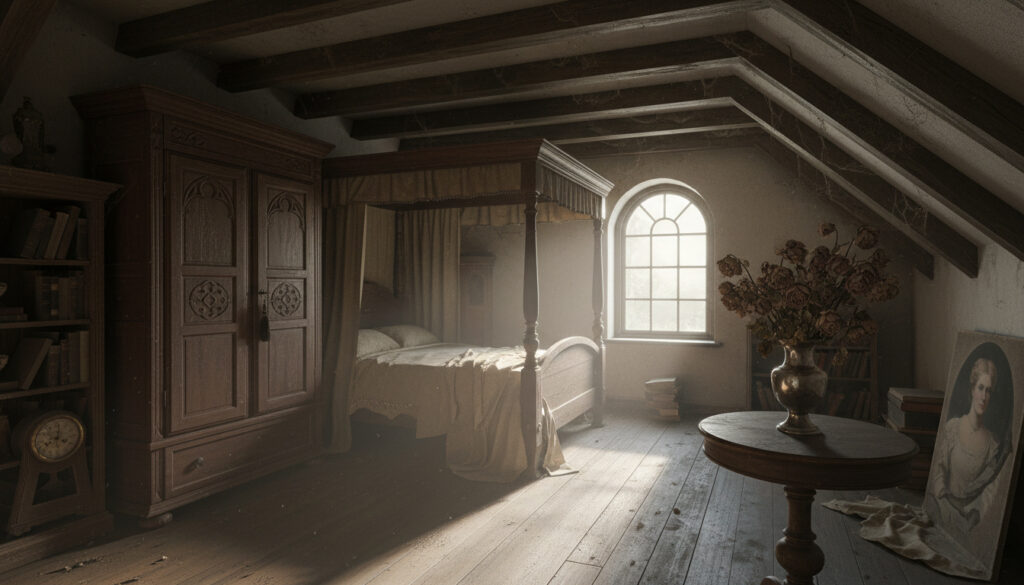
Flowers in the Attic – Gothic Family Secrets Explored
First published in 1979, V.C. Andrews’ Flowers in the Attic remains a landmark in gothic fiction, captivating—and shocking—readers with its story of four siblings hidden away in an attic and betrayed by the very adults sworn to protect them. The novel’s blend of family secrets, forbidden love, and psychological horror firmly established its cult status and sparked decades of discussion about its challenging themes.
The narrative’s unflinching approach to taboo subjects led to both immediate controversy and enduring popularity, spawning sequels, film adaptations, and countless literary analyses. Set primarily in the imposing Foxworth Hall, the novel explores claustrophobic isolation, childhood lost to cruelty, and the difficult moral terrain crossed by its characters. Its ability to unsettle and provoke remains central to its cultural resonance.
As both a product of its time and an enduring influence, Flowers in the Attic (Wikipedia) continues to attract new generations of readers, critics, and creators, each seeking to make sense of its haunting world and the legacy it forged in gothic fiction.
What is the plot of Flowers in the Attic?
| Book Title | Author | Publication Date | Genre |
|---|---|---|---|
| Flowers in the Attic | V.C. Andrews | 1979 | Gothic Fiction |
- Chilling narrative of four siblings hidden in a grand Virginia mansion’s attic
- Transformation from childhood innocence to traumatic awakening
- Unfolding betrayals by maternal and familial figures, driven by greed and secrets
- Progression toward autonomy through acts of desperation and self-reliance
- Escalation of abuse culminating in death, escape, and vows of revenge
- Intertwining themes of taboo love, repression, and loss of innocence
| Setting | Pennsylvania and Foxworth Hall, Virginia |
|---|---|
| Initial Family Structure | Parents (Christopher Sr. & Corrine), children Chris, Cathy, Cory, and Carrie |
| Inciting Event | Father’s sudden death, financial ruin |
| Central Conflict | Siblings imprisoned in attic to obscure their parentage |
| Key Turning Points | Mother’s neglect, Cory’s death, incestuous relationship, discovery of poisoning |
| Climax | Escape to Florida, vow for retribution against Corrine |
| Major Antagonists | Corrine and Olivia Foxworth |
| Major Motifs | Attic as prison, poisonous food, biblical punishment, inheritance |
| Notable Adaptation | 1987 film, multiple miniseries |
| Source | Flowers in the Attic (Sobrief) |
Who are the main characters in Flowers in the Attic?
Cathy Dollanganger: Journey from Innocence to Bitterness
Cathy begins the novel at twelve, quickly shifting from naivety to resilience as she faces captivity and betrayal. Her narrative voice reveals mounting trauma, fractured familial trust, and ultimately, a burning resolve for justice. The complexities of her relationship with Chris and her evolving feelings toward Corrine anchor much of the emotional turmoil.
Chris Dollanganger: Protector and Transgressor
Chris assumes responsibility as the oldest sibling, demonstrating intelligence and adaptability—exemplified by creating a key to aid survival. His role shifts from caretaker to a conflicted perpetrator, most notably as his jealousy sparks the novel’s most controversial act. His devotion to Cathy blurs the boundaries of sibling love and survival necessity.
Cathy and Chris’s relationship embodies the corrosive effects of isolation, transforming mutual reliance into romantic obsession. Their bond complicates traditional depictions of sibling loyalty, reflecting the psychological extremes that captivity can induce. (source)
Corrine and Olivia Foxworth: Portraits of Betrayal
Corrine’s descent into selfish ambition marks a radical departure from expected maternal devotion. Her prioritization of inheritance—and complicity in her children’s suffering—positions her as a key antagonist. Olivia, Corrine’s mother, administers biblical punishments and exerts psychological control, imbuing Foxworth Hall with omnipresent dread.
The Twins, Bart, and Malcolm: Collateral and Catalyst
Cory and Carrie exemplify the physical and emotional costs of confinement, with Cory’s demise serving as a pivotal motivator for escape. Bart Winslow enters as Corrine’s new partner, inadvertently fanning the family’s destructive dynamic. Malcolm, the reclusive patriarch, exerts profound influence as the origin of the family’s secret and inheritance-driven trauma.
What major themes are explored in Flowers in the Attic?
Exploration of Taboo and Family Secrets
The narrative fixes on incest, forbidden love, and the devastating weight of secrets, drawing directly from gothic tradition. The children’s relationship, formed first from survival and later complicated by sexual awakening, highlights the destructive power of repression and isolation. (source)
Motifs of Abuse, Betrayal, and Religion
Physical and emotional abuse saturate the siblings’ ordeal, from starvation and imprisonment to poisoned food. Corrine’s betrayal for inheritance, compounded by Olivia’s rigid puritanism, frames much of the children’s suffering as both familial and religious punishment.
Foxworth Hall’s attic functions as a symbol of repression and family shame, confining not only bodies but secrets. The decaying mansion mirrors the moral breakdown of the family, while everyday objects—like the poisoned doughnuts—assume sinister new meaning. (source)
Class, Corruption, and Survival
Themes of social class and inheritance drive the action, exposing how wealth both conceals and perpetuates abuse. The children’s struggle to survive, physically and emotionally, underlines a powerful undercurrent of resilience amid horror.
Flowers in the Attic has been repeatedly challenged and banned due to its depictions of incest and abuse. Despite censorship, the novel remains acclaimed for its daring approach and its influence on later gothic and family drama fiction. (source)
How has Flowers in the Attic been adapted over the years?
Major Film and Television Adaptations
The most notable adaptation arrived in 1987 with Jeffrey Bloom’s film, featuring Louise Fletcher as Olivia. While it aimed to remain faithful to the source, the film softened some of the novel’s darkest moments, focusing on gothic atmosphere and familial menace. Reaction ranged from admiration for its camp to disappointment from fans of the book’s unfiltered brutality. (source)
Differences Between Novel and Adaptations
Film and later television versions often reduced or reinterpreted intense elements—most notably, the taboo relationships and explicit violence. Some adaptations expanded secondary roles or restructured events for narrative clarity, while others chose to emphasize psychological horror over graphic detail.
Audience and Critical Response
Adaptations have garnered mixed critical response. Some viewers appreciated the atmospheric visuals and restraint, while others criticized the loss of psychological nuance and the dilution of the novel’s shocks. The persistent revisiting of this story in different formats attests to its cultural hold and continuing fascination.
Timeline: Key Events in the History of Flowers in the Attic
- : Original publication of Flowers in the Attic by V.C. Andrews
- : First film adaptation released, directed by Jeffrey Bloom
- : Additional sequels and ongoing public debate
- : Novel re-evaluated in academic and popular circles; continued cult following
- : Renewed interest through digital streaming, new adaptations, and critical analysis
What is known and what remains debated about Flowers in the Attic?
| Established Facts | Points of Uncertainty |
|---|---|
| First published in 1979 by V.C. Andrews | The degree to which autobiographical elements influenced the novel |
| Inspired multiple adaptations, especially the 1987 film | Precise reasons for some adaptation changes |
| Themes: incest, abuse, class, and religion | Interpretation of key character motivations |
| Regularly banned for controversial content | Long-term impact on readers and genre opinions |
| Became foundation for a major gothic saga | Extent of public or critical consensus on the ending |
How does Flowers in the Attic fit into the context of gothic literature and its era?
Drawing from the legacy of gothic novels, Flowers in the Attic stands out for its modern take on ancestral secrets, familial decay, and psychological imprisonment. The mansion—both physical and metaphorical—serves as a crucible of secrecy and suppressed desires. At publication, its raw exploration of taboo and abuse set it apart, igniting powerful reactions rarely seen in contemporaneous genre fiction.
The reception at release was polarizing, with some critics condemning its sensationalism and others lauding its fearless thematic scope. Over time, scholarly interest has reframed the novel as a case study in the evolution of domestic gothic fiction. V.C. Andrews’ use of first-person narration rendered Cathy’s trauma immediate and intimate, a technique that continues to influence writers exploring the gothic and psychological thriller genres.
For additional context, see the analysis on Flowers in the Attic (Wikipedia). In-depth commentary is also available in Flowers in the Attic (Sobrief).
What are authoritative perspectives on Flowers in the Attic?
“V.C. Andrews’ first-person narration transforms a sensational melodrama into a disturbing psychological journey, implicating the reader in the children’s ordeal.”
— Literary Review, via Academia.edu
“Its power lies not merely in how it shocks, but in forcing a re-examination of the boundaries of familial loyalty and trust.”
— Contemporary Critic, via Library of Congress
What is the lasting impact and summary of Flowers in the Attic?
Nearly half a century after its first release, Flowers in the Attic remains central to debates about transgressive fiction, shaping both readers’ expectations and the trajectory of gothic storytelling. For comprehensive background and evolving scholarship, consult Flowers in the Attic (Wikipedia).
Frequently Asked Questions about Flowers in the Attic
What impact did Flowers in the Attic have on the genre of gothic fiction?
Are there any controversies surrounding the book?
How do readers today view its portrayal of family dynamics?
What are some lesser-known facts about its publication history?
Why did V.C. Andrews choose the attic as the primary setting?
Is Flowers in the Attic based on a true story?
How many books are there in the Dollanganger series?
What age is recommended for readers of Flowers in the Attic?
Have any high-profile actors starred in adaptations of the book?
Did V.C. Andrews write all the books in the series?
More related posts
 What Do Statins Do – Clear Benefits for Heart Health
 How To Shrink Bunions Naturally – Simple Foot Relief
 Cast of The Boys: Complete Actors List for Seasons 1-5
 Real Madrid vs Man City Stats – Rivalry And Strategy
 Elizabeth Dulau: Biography, Age, Andor & Wicked Roles
 Central Asian Shepherd Dog – Heritage And Care Guide
 Boots Ear Wax Removal – Cost, Booking and Process Guide
 Things to Do in Bath – Top Attractions and Itineraries