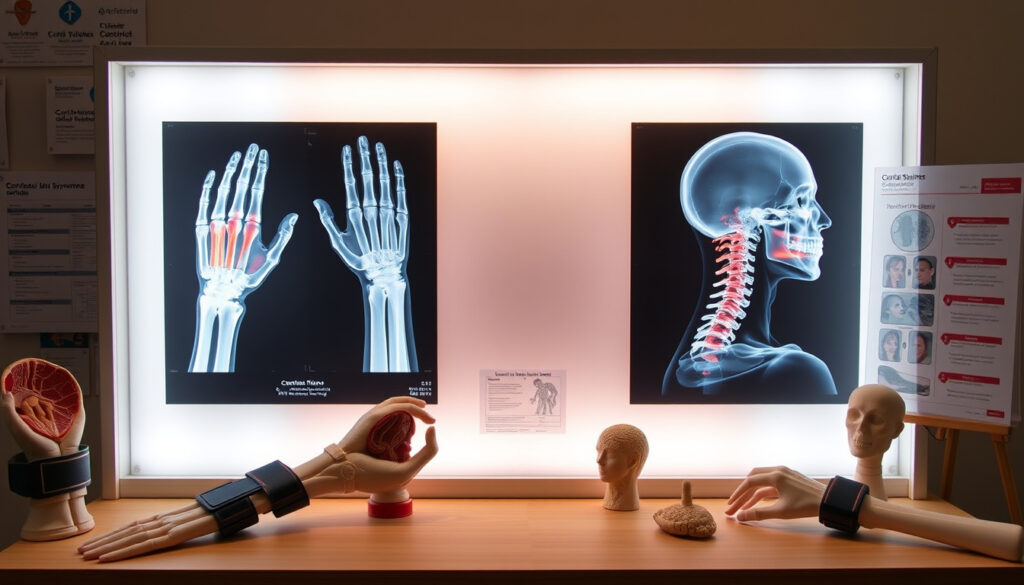
Two Conditions That Are Often Misdiagnosed as Carpal Tunnel Syndrome
Waking up with numb hands is surprisingly common—and so is guessing wrong about what’s causing it. Tendonitis and rheumatoid arthritis keep landing in the wrong diagnostic box, according to orthopedic specialists who point to these as the most frequent culprits behind carpal tunnel misdiagnoses.
Top Misdiagnosis 1: Tendonitis · Top Misdiagnosis 2: Rheumatoid Arthritis · Key Differentiator: Pinky finger unaffected in CTS · Associated Autoimmune: Rheumatoid Arthritis · Vitamin Link Explored: B12 and D Deficiencies
Quick snapshot
- Tendonitis and rheumatoid arthritis are the two conditions most frequently mistaken for carpal tunnel syndrome (Harley Clinic)
- CTS cannot affect the pinky finger; arthritis can affect all fingers including the pinky (Harley Clinic)
- Whether vitamin B12 or D deficiency directly causes carpal tunnel syndrome remains debated in the literature
- The exact mechanism linking rheumatoid arthritis swelling to median nerve compression is not fully quantified
- RA symptoms typically develop symmetrically over weeks to months; CTS often starts unilaterally and may worsen at night (Michigan Medicine)
- Getting the right diagnosis requires knowing which questions to ask—and which symptoms to track before your appointment (Harley Clinic)
Key facts about carpal tunnel misdiagnosis patterns help patients and clinicians narrow down the actual cause of hand symptoms.
| Key Fact | Detail |
|---|---|
| Primary Misdiagnoses | Tendonitis, Rheumatoid Arthritis |
| CTS Symptom Hallmark | Median nerve compression |
| Pinky Finger Test | Unaffected in CTS |
| Nighttime Peak | CTS symptoms worsen at night |
| RA Symmetry | Symptoms appear on both sides equally |
| Stiffness Duration | More than 30 minutes in the morning indicates inflammatory arthritis |
| Arthritis Prevalence | Over 24% of adults affected |
| Systemic vs. Local | RA affects joints, skin, eyes, heart, lungs; CTS is localized to wrist and hand |
What Could Be Mistaken for Carpal Tunnel?
The short answer involves two conditions that share enough symptoms with carpal tunnel syndrome to fool even experienced clinicians: tendonitis and rheumatoid arthritis. Both produce hand pain, tingling, and weakness—exactly what patients expect from CTS. Great Basin Orthopedics notes that swelling around joints and tendons in RA can compress nearby nerves, producing symptoms that look virtually identical to median nerve compression.
Tendonitis as a Common Mimic
Tendonitis occurs when the tendons in the wrist or hand become inflamed, resulting in pain, swelling, and limited range of motion. It typically involves localized pain near the affected tendon and is aggravated by specific movements. Great Basin Orthopedics explains that this inflammation can press on surrounding structures, creating a sensation of numbness or weakness that gets attributed to nerve problems rather than soft tissue damage.
- Pain is localized near the affected tendon and worsens with specific movements
- Typically caused by repetitive use or overuse—common in office workers, musicians, and athletes
- Swelling is visible and tender to the touch, whereas CTS numbness usually isn’t accompanied by obvious inflammation
If you spend hours typing and your wrist hurts when you grip things, tendonitis is a real possibility. Treating it like CTS—wearing a wrist brace instead of addressing the tendon inflammation—won’t solve the problem.
Rheumatoid Arthritis Overlap
Rheumatoid arthritis is an autoimmune disorder in which the immune system attacks the healthy synovial membrane within joints, targeting several joints at once and producing inflammation and pain. Michigan Medicine emphasizes that RA is a systemic disease that can affect multiple systems in the body, including joints, skin, eyes, heart, and lungs—not just the hands.
- Early-stage RA is easily mistaken for carpal tunnel syndrome because the hand symptoms look similar
- RA causes swelling that compresses the median nerve inside the carpal tunnel
- Patients often have bilateral symptoms—affecting both hands equally—while CTS frequently starts on one side
If your hand pain comes with morning stiffness lasting longer than 30 minutes, that signal points toward inflammatory arthritis rather than isolated nerve compression.
Do I Have Carpal Tunnel or Arthritis?
Distinguishing between these conditions requires looking at symptom patterns, timing, and which parts of the hand are affected. One of the most reliable tests doesn’t require any medical equipment: check whether your pinky finger is involved.
Symptom Differences
Carpal tunnel syndrome cannot affect the pinky finger, whereas arthritis can affect all the fingers including the pinky. Harley Clinic highlights this as a key differentiator that patients can use at home. The median nerve—the one compressed in CTS—doesn’t provide sensation to the pinky side of the hand. If your pinky tingles or hurts along with your other fingers, the problem is likely arthritis rather than carpal tunnel.
- CTS primarily affects the thumb, index, middle, and half of the ring finger (the median nerve distribution)
- Arthritis can affect all fingers, including the pinky
- RA-related pain is more likely to be symmetrical, affecting both hands equally, whereas CTS often starts in one hand
Another major difference involves timing. Carpal tunnel syndrome tends to be worse at night, whereas arthritis is not affected by time of day. Harley Clinic explains that this happens because people often sleep with flexed wrists, which narrows the carpal tunnel further. If you’re waking up with numb hands more often than you experience pain during the day, that pattern points toward CTS.
Diagnostic Tests
Doctors have several tools to confirm which condition you’re dealing with. Michigan Medicine notes that if morning stiffness lasts longer than 30 minutes, it indicates rheumatoid arthritis or another inflammatory arthritis; if stiffness improves in less time, it is more likely osteoarthritis. Blood tests for rheumatoid factor, anti-CCP antibodies, and inflammatory markers (ESR, CRP) can identify RA even before joint damage appears on imaging.
- Nerve conduction studies confirm median nerve compression in CTS
- X-rays and ultrasound can reveal joint damage and synovial inflammation in arthritis
- Morning stiffness duration longer than 30 minutes strongly suggests inflammatory arthritis
Track when your symptoms occur and which fingers are affected for at least a week before your appointment. That data alone can dramatically narrow the diagnostic possibilities.
Can Lack of B12 Cause Carpal Tunnel?
Vitamin B12 deficiency is often cited as a potential contributor to nerve problems, including symptoms that can resemble carpal tunnel syndrome. B12 is essential for maintaining the myelin sheath that protects nerves, and deficiency can cause numbness, tingling, and weakness in the extremities. Docus notes that diabetic neuropathy—which shares many features with CTS—can also be influenced by nutritional deficiencies.
Vitamin B12 Deficiency Symptoms
Low B12 levels can cause peripheral neuropathy that affects the hands bilaterally, creating numbness and tingling patterns that differ from the unilateral median nerve compression typical of CTS. People with B12 deficiency often experience additional symptoms like fatigue, weakness, weight loss, and in severe cases, cognitive changes. The neurological symptoms typically develop gradually and may worsen over time if left untreated.
- B12-related neuropathy usually affects both hands simultaneously
- Often accompanied by fatigue, pale skin, and cognitive symptoms
- Common in vegans, vegetarians, older adults, and people with gastrointestinal absorption issues
Evidence from Studies
While B12 supplementation has been explored as a potential treatment for nerve compression, the evidence for it directly causing carpal tunnel syndrome remains limited. Advanced Reconstruction points out that arthritis affects over 24% of adults and can be misdiagnosed as carpal tunnel syndrome—far more prevalent than isolated B12-related neuropathy as a cause of hand symptoms.
Vitamin D has also been studied in relation to musculoskeletal pain, with some research suggesting that deficiency may contribute to widespread pain and inflammation. However, the direct link to carpal tunnel syndrome remains unclear, and most orthopedic specialists view it as a secondary factor rather than a primary cause.
If you have persistent hand numbness alongside fatigue, weakness, or balance problems, ask your doctor to check your B12 levels. It’s a simple blood test that could rule out a nutritional cause—or catch one that needs treatment alongside any CTS care.
What Autoimmune Disease is Associated with Carpal Tunnel?
Rheumatoid arthritis stands out as the autoimmune condition most directly linked to carpal tunnel syndrome. The connection isn’t coincidental: RA causes inflammation and swelling inside the wrist joint that physically compresses the median nerve as it passes through the carpal tunnel.
Rheumatoid Arthritis Connection
Rheumatoid arthritis is a systemic disease that can affect multiple systems in the body, including joints, skin, eyes, heart, and lungs. Great Basin Orthopedics emphasizes that the systemic nature of RA means that treating CTS symptoms alone won’t address the underlying inflammatory process driving the nerve compression.
- RA patients have a higher incidence of CTS due to synovial inflammation inside the carpal tunnel
- Swelling around joints and tendons in rheumatoid arthritis compresses nearby nerves
- Effective RA treatment often resolves CTS symptoms without targeted nerve surgery
Rheumatoid arthritis is easily mistaken for carpal tunnel syndrome in the early stages, Harley Clinic warns. Early RA may present with only hand symptoms before systemic features like fatigue, joint swelling, or morning stiffness become obvious. This means patients can undergo CTS surgery only to find their symptoms persist because the real problem is inflammatory arthritis.
Lupus Mimicry
Systemic lupus erythematosus (lupus) can also produce hand symptoms that overlap with CTS. While less frequently cited than RA, lupus can cause joint inflammation, swelling, and in some cases, vasculitis that affects nerve function. Medical News Today reports that multiple sclerosis can be mistaken for carpal tunnel syndrome due to overlap in symptoms, with documented cases of MS initially misdiagnosed as carpal tunnel syndrome due to tingling in the index, middle, and ring fingers. This illustrates how wide the diagnostic confusion can be.
If you’ve had CTS release surgery but symptoms return—or if they never fully resolved—ask your doctor whether autoimmune screening might be appropriate. The systemic nature of RA means localized treatments often fail.
What Happens if Carpal Tunnel Goes Untreated?
Ignoring carpal tunnel syndrome doesn’t make it disappear. Over time, median nerve compression causes permanent damage that no longer responds to conservative treatment—and the symptoms can spread beyond the hand.
Pain Radiation Patterns
Cervical radiculopathy occurs when a nerve in the neck is compressed or irritated, often due to disc bulges, degeneration, or arthritis of the cervical spine. Joint Injections UK explains that cervical radiculopathy pain and nerve symptoms can travel down the arm into the hand and fingers, closely mimicking symptoms of carpal tunnel syndrome. This means untreated CTS—or misdiagnosed cervical spine problems—can cause pain radiating to the shoulder and neck.
- Pain can radiate from the wrist up through the forearm to the shoulder and neck
- Numbness and weakness may progress from intermittent to constant
- Cervical spine issues are frequently misdiagnosed as CTS when symptoms affect the thumb, index, and ring fingers
Long-term Risks
The longer median nerve compression continues, the harder it becomes to reverse. Early CTS treatment with splinting, activity modification, and anti-inflammatory measures often works. Great Basin Orthopedics notes that CTS primarily affects the fingers and palm side of the hand, often worsening at night or during repetitive wrist and hand movements. Without intervention, patients can develop permanent numbness, muscle wasting in the thumb base, and chronic weakness that affects grip strength.
- Permanent nerve damage results in ongoing numbness even after surgery
- Thenar muscle atrophy (wasting of thumb muscles) becomes irreversible
- Quality of life deteriorates as hand function declines
If you’ve been treating your hand symptoms as CTS for more than a few months without improvement, something else may be going on. The longer the misdiagnosis continues, the more damage accumulates—whether the root cause is RA, cervical radiculopathy, or actual CTS.
Conditions Comparison
Three main conditions share carpal tunnel-like symptoms, but each has distinct features that help differentiate them.
| Feature | Carpal Tunnel Syndrome | Tendonitis | Rheumatoid Arthritis |
|---|---|---|---|
| Affected Fingers | Thumb, index, middle, half of ring finger (median nerve) | Localized to affected tendon area | All fingers including pinky |
| Symmetry | Often starts in one hand | Usually unilateral | Symmetrical—both hands equally |
| Timing Pattern | Worse at night, improves with movement | Worse with specific movements | Not time-dependent; morning stiffness >30 min |
| Visible Signs | May have muscle wasting in late stages | Swelling, tenderness over tendon | Joint swelling, redness, warmth |
| Systemic Symptoms | None | None | Fatigue, fever, weight loss possible |
| Primary Cause | Nerve compression in wrist | Tendon inflammation from overuse | Autoimmune attack on joint lining |
The pattern here shows that CTS stays localized to the hand while RA spreads systemically—and this distinction guides which specialist you should see first.
Confirmed vs. Unclear
What the research confirms
- Tendonitis and rheumatoid arthritis are the two conditions most frequently misdiagnosed as CTS, according to orthopedic specialists
- Carpal tunnel syndrome cannot affect the pinky finger; arthritis can affect all fingers
- RA symptoms are typically symmetrical, affecting both hands equally
- CTS symptoms worsen at night due to wrist flexion during sleep
- Swelling around joints and tendons in RA physically compresses the median nerve
- Morning stiffness longer than 30 minutes indicates inflammatory arthritis rather than osteoarthritis
What remains unclear
- Whether B12 or D deficiency directly causes carpal tunnel syndrome or merely contributes to peripheral neuropathy that mimics it
- The precise threshold at which RA-related swelling reliably produces CTS symptoms versus other nerve compression patterns
- Whether early CTS surgery in RA patients prevents long-term nerve damage or simply addresses symptoms while the underlying autoimmune process continues
Doctors may rely heavily on information about where the pain occurs and when the pain first started to determine whether an issue is arthritis or tendonitis. An achy knee that has been slowly getting worse over the years is more apt to be osteoarthritis, whereas someone who suddenly has pain behind their ankle probably has Achilles tendonitis.
— CreakyJoints (Patient advocacy organization for arthritis)
People with rheumatoid arthritis may have systemic symptoms including fatigue, fever, weight loss, eye inflammation, anemia, subcutaneous nodules, and pleurisy. This systemic nature distinguishes RA from purely localized conditions like tendonitis or isolated carpal tunnel syndrome.
— Advanced Ortho Centers (Orthopedic specialists)
Bottom line
For patients experiencing hand numbness and tingling, the stakes of getting the right diagnosis are high. Tendonitis and rheumatoid arthritis both masquerade as carpal tunnel syndrome, but they demand fundamentally different treatment approaches. RA requires systemic management—DMARDs, biologics, immune suppression—while tendonitis responds to rest, ice, and activity modification. CTS, if confirmed, may need splinting, injections, or surgical release. Michigan Medicine notes that if morning stiffness lasts longer than 30 minutes, it indicates rheumatoid arthritis or another inflammatory arthritis—a threshold that should trigger autoimmune screening before any surgical intervention on the wrist.
For anyone who has spent months treating hand symptoms as CTS without relief, the message is clear: the pinky finger test, symmetry check, and morning stiffness duration are three questions worth asking before accepting a carpal tunnel diagnosis. Harley Clinic confirms that arthritis affects all the fingers including the pinky, whereas CTS cannot affect the pinky—making this a simple at-home filter that could redirect your care toward the actual problem.
What this means for patients: orthopedic specialists who order autoimmune screening before recommending CTS surgery spare their patients from unnecessary procedures and ensure the underlying condition gets appropriate treatment.
Related reading: Two conditions that are often misdiagnosed as carpal tunnel syndrome · These two conditions are often misdiagnosed as carpal tunnel syndrome
Related coverage: early carpal tunnel symptoms fördjupar bilden av Carpal Tunnel Syndrome Symptoms – Early Signs and When to See Doctor.
Frequently asked questions
How do you self test for carpal tunnel?
Check which fingers are affected. CTS affects only the thumb, index, middle, and half of the ring finger—the median nerve distribution. If your pinky tingles or hurts, CTS is unlikely. Also note whether symptoms worsen at night; CTS typically does, while arthritis doesn’t follow a time-of-day pattern.
What vitamin deficiency causes carpal tunnel?
No vitamin deficiency directly causes carpal tunnel syndrome, but B12 deficiency can cause peripheral neuropathy with similar symptoms. If you have hand numbness alongside fatigue, weakness, or cognitive changes, ask your doctor about B12 testing. Vitamin D deficiency has been linked to musculoskeletal pain but isn’t a recognized cause of CTS.
What time of day is carpal tunnel the worst?
Carpal tunnel syndrome symptoms typically worsen at night. This happens because many people sleep with their wrists flexed, which narrows the carpal tunnel and increases pressure on the median nerve. Waking up with numb hands that improve after shaking them out is a classic CTS pattern.
Can carpal tunnel pain radiate to shoulder and neck?
Yes, but the cause may be cervical radiculopathy rather than CTS. A compressed nerve in the neck (from disc bulges or cervical arthritis) can cause referred pain that travels down the arm into the hand, mimicking CTS symptoms. This condition is frequently misdiagnosed as carpal tunnel syndrome.
Can you have carpal tunnel without numbness and tingling?
Early CTS may present with pain and weakness rather than classic numbness. Some patients first notice difficulty gripping objects, dropping things, or weakness in the thumb. Numbness and tingling typically develop as the condition progresses, but not always in a predictable sequence.
How can you tell the difference between carpal tunnel and neuropathy?
CTS typically affects only one hand initially and follows the median nerve distribution. Generalized neuropathy—often from diabetes or B12 deficiency—usually affects both hands symmetrically and may involve symptoms in the feet as well. A nerve conduction study can definitively differentiate between these conditions.
More related posts
 Neil Patrick Harris Amy Winehouse Cake: Facts & Apology
 Jang Ki-yong: Age, Height, Dramas, Agency & Instagram
 Klondike Solitaire: Rules, Turn 1 & Free Online Play
 Sam Mendes: Biography, Movies, Wives & Beatles Films
 Who Is The New Pope 2025 – New Leadership, Global Vision
 Live Cricket Match Today – England Vs New Zealand Clash
 Maxi Dress for Women: Wedding, Summer, Sleeves Guide
 What Is a Limited Company – Definition, Types, Pros and Cons