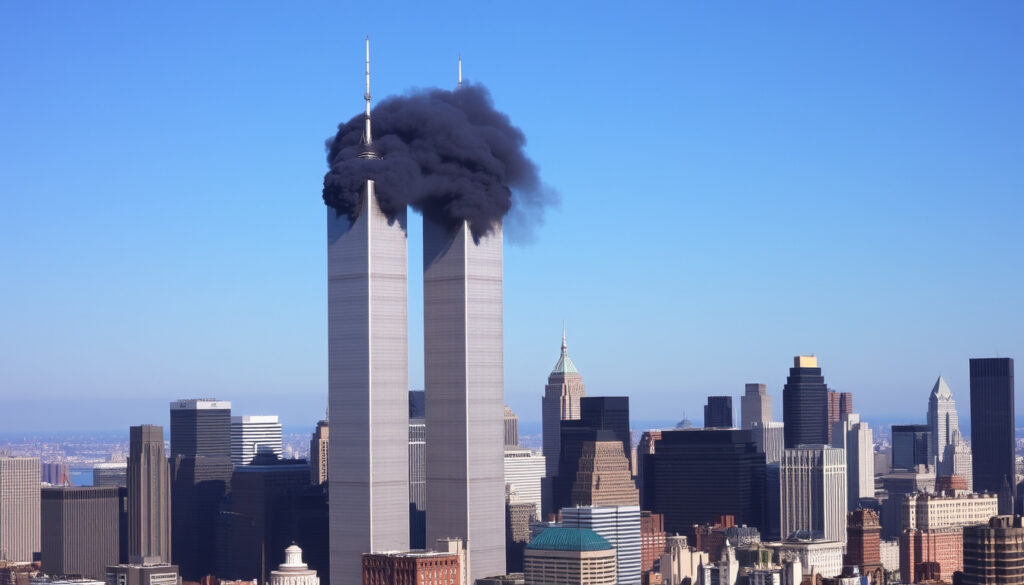
9/11 Attack: Causes, Events, Survival and Aftermath Explained
For those who lived through September 11, 2001, the memory remains vivid: planes rerouted, phone lines overwhelmed, dust settling over lower Manhattan. Questions still surface decades later about the mechanics of the attacks, survival odds inside the towers, and what became of the nearly 3,000 who died.
Date: September 11, 2001 · Perpetrators: Al-Qaeda · Planes Hijacked: 4 · Targets Hit: World Trade Center, Pentagon
Quick snapshot
- Al-Qaeda executed four coordinated hijackings on September 11, 2001 (9/11 Memorial)
- The North Tower fell at 10:28 AM, the South Tower at 9:59 AM (John Jay College Timeline)
- Nearly 3,000 lives lost on 9/11 (9/11 Memorial)
- Full identification of all remains from top-floor victims remains incomplete
- Exact identities of four South Tower survivors beyond Ron DiFrancesco
- The 16-minute gap between crashes gave South Tower upper floors a partial evacuation window (USA Today)
- Betty Ann Ong alerted Flight 11 hijacking at 8:19 AM—27 minutes before impact (Miller Center)
- Victim identification continues via DNA analysis at the Office of the Chief Medical Examiner
- The 9/11 Memorial receives millions of visitors annually, maintaining the historical record
Key data points from official sources reveal the scale and progression of the attacks.
| Label | Value |
|---|---|
| Date | September 11, 2001 |
| Organization | Al-Qaeda |
| Buildings Destroyed | Seven in World Trade Center |
| Complex Size | 16-acre |
| North Tower deaths | 1,434 |
| South Tower deaths | 599 |
| South Tower survivors above impact | 4 |
What caused 911 to happen?
Al-Qaeda, the extremist organization founded by Osama bin Laden, carried out the September 11 attacks as the climax of a years-long campaign of violence against American targets. The group issued statements declaring holy war against the United States, vowing death to Americans and demanding the withdrawal of U.S. military forces from the Middle East.
Al-Qaeda planning
Al-Qaeda operatives spent months training at flight schools in the United States while plotting the operation. The attackers obtained valid visas, blended into American communities, and practiced flying commercial jets without any intention of landing.
- Flight 11 departed Boston at 7:59 AM with 76 passengers, 11 crew, and 5 hijackers aboard (Miller Center)
- Flight 175 took off from Boston at 8:15 AM carrying 51 passengers, 9 crew, and 5 hijackers (Miller Center)
Hijacker motivations
The hijackers viewed the attacks as religious duty, interpreting their actions through a lens of Islamic jihad. The 9/11 Commission Report documented how the group justified mass civilian casualties as acceptable within their ideological framework.
The attackers deliberately chose the United States as a target, selecting specific buildings and dates to maximize casualties and media attention. Their planning included backup scenarios and contingency protocols for each flight.
What Were the 9/11 Terrorist Attacks?
On the morning of September 11, 2001, al-Qaeda terrorists hijacked four commercial passenger planes and turned them into weapons directed at the United States. The coordinated strikes killed nearly 3,000 people at three different sites.
Hijacked planes
- American Airlines Flight 11: Struck the North Tower between floors 93-99 at 8:46 AM (USA Today)
- United Airlines Flight 175: Hit the South Tower between floors 77-85 at 9:03 AM (USA Today)
- American Airlines Flight 77: Crashed into the Pentagon at 9:37 AM (Miller Center)
- United Airlines Flight 93: Crashed in Pennsylvania after passengers attempted to retake the plane at 10:03 AM (National Park Service)
Targets struck
The World Trade Center in lower Manhattan bore the heaviest toll, with both towers collapsing within two hours of the initial strike. The Pentagon attack killed 125 people on the ground. Flight 93 passengers thwarted a fourth attack, likely targeting the U.S. Capitol or White House.
The coordinated nature of the attacks meant emergency responders had no warning when the second plane hit. City officials were already managing one catastrophe when the South Tower was struck, fundamentally altering rescue operations from the start.
Why did the Twin Towers fall if they were hit at the top?
The towers fell not because the upper floors collapsed under the planes’ weight, but because the impacts severed critical structural columns while simultaneously igniting fires that weakened the remaining steel framework. According to the 9/11 Commission Report, the combination of direct structural damage and fire-induced steel softening triggered progressive collapse.
Structural failure
The towers were engineered as steel tube structures with a perimeter of thin, closely spaced columns that provided much of the buildings’ strength. When jets struck, they sliced through multiple perimeter columns and core columns simultaneously, removing load-bearing capacity in seconds.
Fire and impact damage
- The jet fuel from both planes ignited fires that burned at temperatures sufficient to weaken structural steel
- Impact forces dislodged fireproofing from steel components, leaving them exposed to heat
- As damaged sections buckled under weight, undamaged sections could not support the redistributed loads
- The towers fell in a pattern resembling controlled demolition, with the upper portion pancaking onto lower floors
Fireproofing standards at the time assumed accidental fires, not jet-fuel infernos consuming an entire floor simultaneously. The collapse revealed that high-rise buildings faced risks engineers had not previously modeled or designed against.
The 16-acre World Trade Center complex opened in 1973 and had previously survived the 1993 truck bombing that killed six people and injured over 1,000 (John Jay College Timeline). The February 26, 1993 bombing caused extensive damage to the parking garage beneath the towers, but structural engineers determined the buildings remained sound.
Did anyone on the top floors survive 9/11?
Survival above the impact zones was extraordinarily rare, but four people escaped from the South Tower by navigating an unblocked stairwell while everyone above the 81st floor perished in the North Tower.
Elevator miracle
In the South Tower, an estimated 16 minutes elapsed between the first and second plane crashes—enough time for some workers above the impact zone to attempt evacuation. Four people reached Stairway A, which remained passable below the impact zone. They descended through smoke and darkness to safety.
- The South Tower had four survivors above the impact zone (USA Today)
- No one survived above the 92nd floor in the North Tower (USA Today)
- Ron DiFrancesco, one of the four survivors, escaped from approximately the 91st floor of the South Tower
Stairway escape
The North Tower presented a grimmer picture. After Flight 11 struck between floors 93-99, all elevator shafts and stairwells were severed at the impact zone, trapping everyone on higher floors with no escape route. Employees on floors above the 91st floor faced certain death.
Below the impact zones, survival rates were dramatically different. Approximately 99% of the 5,000-7,000 workers in both towers escaped from below the strikes—1,434 died in the North Tower compared to 599 in the South Tower (USA Today).
Many trapped in the South Tower went upward toward the roof, assuming helicopter rescue was possible. Roof access doors were locked, and smoke filled the upper floors, making that escape route impossible (USA Today).
Are there any people still missing from 9/11?
More than two decades after the attacks, the Office of the Chief Medical Examiner continues working to identify human remains recovered from the World Trade Center site. The work involves DNA analysis of fragments too small for earlier testing methods.
Victim identification
The process has grown more sophisticated over time. What initially seemed impossible to identify through visual recognition alone now yields results through genetic technology. Each match provides closure for families who have waited decades.
Ongoing lab work
According to the 9/11 Memorial, thousands of tissue fragments remain unmatched. The medical examiner periodically announces new identifications, sometimes decades after the initial recovery. Families receive confirmation when scientists link a fragment to their loved one’s DNA profile.
For hundreds of families, no remains have ever been identified. The magnitude of the collapse—in which buildings pulverized concrete and mixed human remains with debris—created identification challenges unlike any previous disaster. The process will likely continue for years, with each announcement bringing both grief and hard-won resolution.
Timeline of 9/11 Events
- : Flight 11 takes off from Boston (Miller Center)
- : Betty Ann Ong alerts flight attendants to hijacking on Flight 11
- : Flight 11 strikes North Tower between floors 93-99 (USA Today)
- : Flight 175 strikes South Tower between floors 77-85 (John Jay College Timeline)
- : Flight 77 crashes into the Pentagon
- : South Tower collapses (Miller Center)
- : Flight 93 crashes in Pennsylvania (National Park Service)
- : North Tower collapses (Wikipedia)
Confirmed facts
- Al-Qaeda carried out four coordinated hijackings on September 11, 2001
- Flight 11 struck the North Tower at 8:46 AM, Flight 175 hit the South Tower at 9:03 AM
- South Tower collapsed at 9:59 AM, North Tower at 10:28 AM
- Four people survived above the South Tower impact zone using Stairway A
- No one survived above the 92nd floor in the North Tower
- 479 first responders died attempting rescues
What remains uncertain
- Full identification of all remains recovered from the site
- Exact identities of all four South Tower top-floor survivors
- Specific reasons why Stairway A remained passable while all other escape routes were blocked
Notable near-misses
Several well-known individuals came close to being on the hijacked flights or were in the towers when the attacks occurred.
Mark Wahlberg was scheduled to fly on Flight 11 but changed his plans and missed the flight. He has spoken publicly about the experience.
— Multiple news reports on celebrity near-misses from 9/11
Everyone on floors 92 and up died; 99% of those below lived. The fate of nearly everyone inside the World Trade Center was sealed the moment the hijacked jets struck.
— USA Today detailed survivor analysis
The 16-minute interval between the two crashes created an unusual situation where some workers in the South Tower began evacuating from upper floors before the second impact. This partial evacuation window accounted for the four top-floor survivors in the South Tower versus zero in the North Tower.
Bottom line: Al-Qaeda killed nearly 3,000 people on September 11, but the numbers could have been far worse. Below the impact zones, 99% of workers survived—proof that early evacuation warnings save lives. The towers fell because fires weakened structural steel after impact damage, not because upper floors collapsed from plane weight alone. Four people above the South Tower impact zone escaped through an unblocked stairwell, while everyone above the North Tower impact zone died.
Summary
The September 11 attacks reshaped American foreign policy, domestic security, and daily life in ways still felt today. New buildings now occupy the Twin Towers’ footprint, and the 9/11 Memorial receives millions of visitors each year honoring those lost. Compensation through the Victim Compensation Fund has provided financial support to survivors and families, while victim identification efforts continue through DNA analysis.
The attacks demonstrated that civilian infrastructure could become a target, leading to permanent changes in airport security, the creation of the Department of Homeland Security, and the launch of military operations in Afghanistan and Iraq. Two decades later, these events continue to shape national security policy and international relations.
Related reading: BAE Systems Share Price: Live Chart, Forecast & Analysis · Chard & Ilminster News: Latest Updates, Crime, Deaths
Frequently asked questions
Which celebrity almost died in 9/11?
Mark Wahlberg was scheduled to fly on American Airlines Flight 11 but changed his travel plans at the last minute. He has publicly discussed this near-miss. Multiple other celebrities were in the towers or scheduled for flights that day.
What famous person missed the 911 flight?
Mark Wahlberg missed Flight 11, as did several other public figures. The flight manifest included ordinary passengers alongside those who changed their plans that morning.
What replaced the Twin Towers?
One World Trade Center (also known as Freedom Tower) opened in 2014 as the lead building of the new World Trade Center complex. The 9/11 Memorial occupies the underground footprints of the original towers, with reflecting pools marking where each building stood.
How much money did 911 survivors get?
The September 11th Victim Compensation Fund has paid billions in claims to survivors and families of victims. The fund was reactivated multiple times, with amounts determined by individual circumstances, severity of exposure, and proximity to the attacks.
What was the World Trade Center complex?
The 16-acre World Trade Center complex opened in 1973 and contained seven buildings. The twin 110-story towers were the centerpiece, standing as the world’s tallest buildings until 1972. The complex included shopping areas, a hotel, and office space for over 50,000 workers.
How did 9/11 affect travel?
Airport security was overhauled immediately after 9/11. The Transportation Security Administration was created in 2001, introducing stricter screening procedures, passenger watchlists, and cockpit security measures that remain in effect today.
What is the 9/11 Memorial?
The National September 11 Memorial and Museum occupies the World Trade Center site. Two reflecting pools mark the exact locations of the original towers, with victims’ names inscribed around their edges. The museum displays artifacts and accounts from the day of the attacks.
More related posts
 Real Madrid vs Atlético Madrid: Head-to-Head, History & Results
 British Airways First Class Review 2025: Is It Worth the Cost?
 Cast of Murder on the Orient Express 2017 – Actors and Roles Guide
 India National Cricket Team: Players, Salaries, Stats
 Margo Martindale Movies And TV Shows – Career Highlights
 Boots Ear Wax Removal – Cost, Booking and Process Guide
 Places to Visit in Edinburgh – Historic Culture Unfolded
 Elizabeth Dulau: Biography, Age, Andor & Wicked Roles