Leonardo da Vinci: Life, Works, and Enduring Mysteries
You know the name Leonardo da Vinci — the Mona Lisa, the flying machines, the legendary genius. But behind the myth lies a real man with a messy life, unanswered questions, and fewer than 20 surviving paintings.
Full name: Leonardo di ser Piero da Vinci ·
Born: April 15, 1452, Vinci, Republic of Florence (Italy) ·
Died: May 2, 1519, Amboise, Kingdom of France ·
Known for: Mona Lisa, The Last Supper, Vitruvian Man, polymath genius ·
Surviving paintings: Fewer than 20 attributed works ·
Sleep habit legend: Polyphasic sleep (20-minute naps every 4 hours)
Quick snapshot
- Born 1452 in Vinci, Italy (Britannica)
- Apprenticed under Andrea del Verrocchio in Florence (The Met)
- Died 1519 at Château du Clos Lucé (Britannica)
- Painted Mona Lisa (c. 1503) and The Last Supper (Google Arts & Culture)
- Exact cause of death remains unknown (OUPblog)
- Sexual orientation: no definitive evidence (OUPblog)
- Polyphasic sleep claim lacks contemporary source (History Hit)
- Mona Lisa sitter identity not 100% confirmed (OUPblog)
- 1452 – Born in Vinci
- 1466–1476 – Verrocchio workshop
- 1482–1499 – Milan; paints The Last Supper
- 1503–1516 – Returns Florence; paints Mona Lisa
- 1516–1519 – France under Francis I; dies
- Ongoing research into attribution of disputed works
- Mona Lisa conservation studies by Louvre (2024–2025)
- Continued scholarly debate on personal life
| Attribute | Value |
|---|---|
| Full name | Leonardo di ser Piero da Vinci |
| Born | April 15, 1452, Vinci, Republic of Florence (Italy) |
| Died | May 2, 1519, Amboise, Kingdom of France |
| Known for | Mona Lisa, The Last Supper, Vitruvian Man, polymath genius |
| Surviving paintings | Fewer than 20 attributed works |
| Sleep habit legend | Polyphasic sleep (20-minute naps every 4 hours) |
| Training | Workshop of Andrea del Verrocchio in Florence (The Met) |
| Patrons | Ludovico Sforza, Cesare Borgia, Francis I (Britannica) |
| Notable notebooks | Anatomy, flight, hydraulics, military engineering (Wikipedia) |
Why is Leonardo da Vinci so famous?
Leonardo’s fame rests on an astonishingly small output of finished paintings — fewer than 20 that scholars confidently attribute to him — yet his cultural footprint is immeasurable. The reason lies partly in the works themselves and partly in the Renaissance context that produced a polymath who saw no boundary between art and science.
The Mona Lisa and The Last Supper
- The Mona Lisa (c. 1503–1506), housed in the Musée du Louvre (Paris), is arguably the most famous painting in the world. Its subject is widely believed to be Lisa Gherardini, though absolute proof remains elusive (OUPblog).
- The Last Supper (c. 1495–1498), painted on the refectory wall of Santa Maria delle Grazie in Milan, is a masterwork of perspective and composition (Britannica).
His diverse talents as a polymath
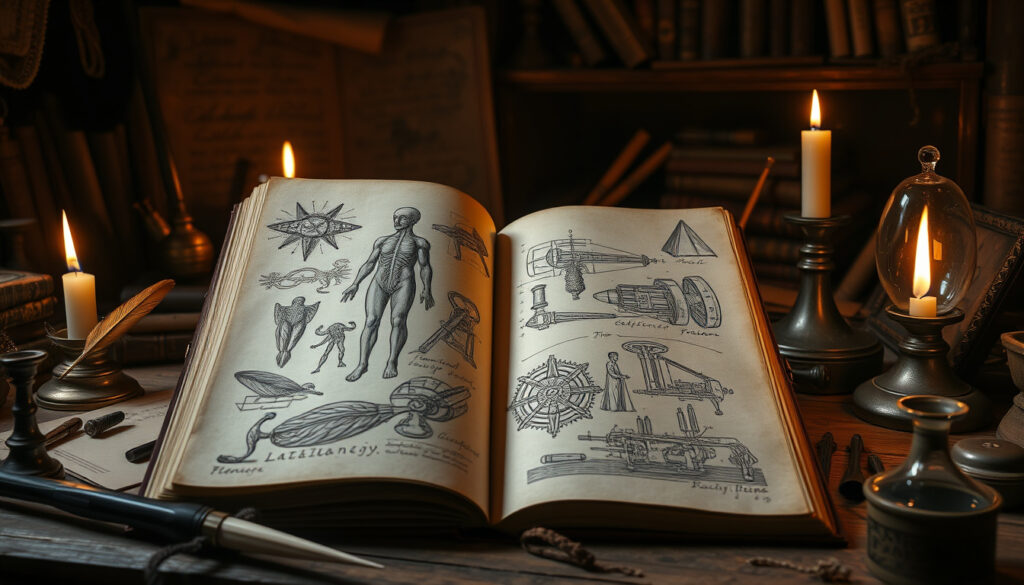
- Leonardo’s notebooks reveal deep studies in anatomy, astronomy, botany, cartography, and paleontology (Wikipedia). He designed flying machines, hydraulic systems, and military fortifications.
- He was a pioneer of sfumato (soft, smoky transitions between colours) and chiaroscuro (strong contrasts of light and shadow), techniques that gave his paintings an unprecedented realism (The Met).
Innovative artistic techniques
- His sfumato technique is especially evident in the Mona Lisa’s enigmatic smile, created by layering thin glazes.
- The Vitruvian Man drawing (c. 1490) is an iconic representation of Renaissance humanism, blending art and mathematics (Britannica).
Legacy and influence
- Leonardo’s work influenced generations of artists, from Raphael to modern painters.
- His notebooks were studied after his death and contributed to the development of anatomy and engineering (OUPblog).
The implication: Leonardo’s fame is not just about two paintings — it’s about the sheer breadth of his curiosity. He was the original Renaissance man, and that archetype continues to fascinate.
Was Leonardo da Vinci LGBTQ?
This question has intrigued historians for centuries, but the evidence is fragmentary. No definitive proof of his sexual orientation exists, and modern scholarship treads carefully around anachronistic labels.
Historical context of Renaissance sexuality
- In 15th-century Florence, homosexual acts were illegal and morally condemned by the Church, though they were not uncommon in the city’s artistic circles.
- Leonardo never married and had no known children — a rarity for a man of his social standing (OUPblog).
Evidence from writings and relationships
- In 1476, Leonardo was publicly accused of sodomy along with three other young men. The charges were dropped for lack of evidence (OUPblog).
- He formed intense friendships with male apprentices, notably Salai (Gian Giacomo Caprotti), who lived with him for decades and is described in his notebooks as a “thief, liar, stubborn, glutton.” Some scholars interpret the relationship as romantic; others see it as a typical master-pupil bond.
- Later in life, he was close to Francesco Melzi, who became his heir (History.com).
Modern scholarly interpretations
- Most historians agree that we cannot assign a modern sexual identity to Leonardo. The term “homosexual” did not exist in his era, and same-sex relationships were understood differently.
- The evidence points to strong emotional bonds with men, but conclusive proof of a physical relationship has not survived.
The catch: the 1476 accusation is the closest we have to a concrete indicator, but it was dismissed. For today’s readers, the safest conclusion is that Leonardo’s sexuality remains an open historical question.
What caused Da Vinci’s death?
Leonardo died on 2 May 1519 at the Château du Clos Lucé in Amboise, France (Britannica). He was 67 (or 67 in his 67th year, depending on the source). Contemporary accounts describe his death as peaceful, following a period of paralysis.
Contemporary accounts
- The earliest biography, by Giorgio Vasari (1550), states that Leonardo “made a good end” and that he died in the arms of King Francis I — though that detail is now considered legendary (Britannica).
- Vasari writes that Leonardo suffered a paralytic stroke before his death, leaving him unable to paint but still able to draw and write.
Medical theories
- Modern historians suggest the cause was likely a stroke or pneumonia — common causes of death in the early 16th century.
- Less supported theories include lead poisoning (from handling paints and lead-based pigments) or syphilis, but no contemporary medical records survive to confirm either (OUPblog).
What this means: we know where and when Leonardo died, but the exact pathology remains uncertain. Given the lack of autopsy or detailed medical notes, the cause can only be inferred from the general context.
How many hours a day did da Vinci sleep?
One of the most persistent myths about Leonardo is that he followed a polyphasic sleep schedule — 20-minute naps every four hours, totalling only 2–3 hours of sleep per day. The idea appeals to productivity culture, but the historical evidence is thin.
The polyphasic sleep theory
- The story originated in later biographies and self-help books rather than any contemporary source (History Hit).
- Leonardo’s notebooks contain scattered references to sleep and rest, but no clear schedule is described.
Historical evidence and skepticism
- Most scholars dismiss the polyphasic schedule as a fabrication. Leonardo lived in a time when people typically slept in two blocks (first sleep and second sleep) with a waking period in between — a common pre-industrial pattern.
- The claim appears to be a modern misinterpretation of a few notebook entries about the value of short rest periods (OUPblog).
The trade-off: the polyphasic sleep myth is a compelling hook, but it’s not grounded in primary evidence. If Leonardo did nap during the day, he was likely following the standard segmented sleep pattern of his era — not a radical productivity hack.
What were Leonardo da Vinci’s most famous paintings?
Leonardo’s painted oeuvre is small, but each surviving work is loaded with significance. Here are the most iconic, with a note that the Vitruvian Man is a drawing, not a painting.
Mona Lisa
- Painted c. 1503–1506, housed in the Louvre, Paris.
- Widely believed to be a portrait of Lisa Gherardini, wife of a Florentine merchant (Google Arts & Culture).
- Famous for its sfumato technique, enigmatic expression, and detailed landscape background.
The Last Supper
- Painted c. 1495–1498 on the refectory wall of Santa Maria delle Grazie, Milan.
- A masterpiece of perspective and narrative composition depicting the moment Jesus announces one disciple will betray him (Britannica).
Lady with an Ermine
- Portrait of Cecilia Gallerani, mistress of Ludovico Sforza, painted c. 1489–1490.
- Held in the Czartoryski Museum, Kraków. Notable for the tight connection between the sitter and the ermine (a symbol of purity).
Virgin of the Rocks
- Two versions exist: one in the Louvre (c. 1483–1486) and one in the National Gallery, London (c. 1491–1508). The London version has later additions by assistants.
- Shows the Virgin Mary with the infant Jesus and John the Baptist in a mysterious, cavernous setting.
Other notable works
- Vitruvian Man (c. 1490) – a drawing, not a painting, but one of the most reproduced images in history.
- Salvator Mundi – a controversial attribution; sold for $450 million in 2017, but many scholars doubt it is entirely by Leonardo (OUPblog).
The pattern: Leonardo’s few paintings are each revolutionary in technique and composition. His fame rests on quality and innovation, not quantity. For readers interested in Renaissance art, Vatican City (home of the Sistine Chapel) offers a deeper look at the cultural ecosystem in which Leonardo worked.
Timeline of Leonardo da Vinci’s Life
- 1452 – Born in Vinci, Republic of Florence (Britannica)
- 1466–1476 – Apprenticed with Andrea del Verrocchio in Florence (The Met)
- 1472 – Master in the Florentine Guild of Saint Luke (The Met)
- 1482–1499 – Works for Ludovico Sforza in Milan; paints The Last Supper (c. 1495–1498)
- 1503–1516 – Returns to Florence; paints Mona Lisa (c. 1503–1506); later travels to Rome and France
- 1516–1519 – Lives in France under patronage of King Francis I; dies 2 May 1519 at Clos Lucé, Amboise
Clarity breakdown: what historians agree on vs. what remains debated
Confirmed facts
- Birth and death dates (1452–1519) are well-documented (Britannica)
- He painted the Mona Lisa and The Last Supper (Google Arts & Culture)
- He was a polymath with contributions to art, anatomy, and engineering (OUPblog)
- He never married and had no known children (History.com)
- He wrote many notebooks in mirror script, but not for secrecy (OUPblog)
What’s unclear
- Exact cause of death (stroke vs. pneumonia vs. other) (OUPblog)
- His sexual orientation (no definitive evidence exists) (OUPblog)
- The authenticity of his polyphasic sleep schedule (History Hit)
- The nature of his relationship with the subject of the Mona Lisa (OUPblog)
Quotes from Leonardo and his contemporaries
“He made a good end… he was 75 years old.”
Giorgio Vasari, “Lives of the Most Excellent Painters, Sculptors, and Architects” (1550), describing Leonardo’s death (Britannica)
“Experience never errs; it is only your judgments that err by promising themselves effects such as are not caused by your experiments.”
Leonardo da Vinci, from his notebooks (Wikipedia)
Leonardo’s own words reveal a relentless empiricist, a man who trusted observation over authority. That mindset is what made him a scientific as well as an artistic pioneer.
For a closer look at his major works, including lesser-known pieces, see our guide to Leonardo da Vincis major works.
Frequently asked questions
Who was Da Vinci’s lover?
No definitive evidence identifies a romantic partner. Historians point to his close relationships with apprentices Salai and Francesco Melzi, but there is no contemporary account of a physical relationship.
Were Mona Lisa and Da Vinci lovers?
There is no evidence for a romantic relationship between Leonardo and the sitter of the Mona Lisa (widely believed to be Lisa Gherardini). The idea is a modern fiction popularised by novels and films.
What are 5 facts about Da Vinci?
- He was born illegitimately in 1452 in Vinci, Tuscany (History.com).
- He apprenticed under Andrea del Verrocchio in Florence (The Met).
- He painted only about 15–20 surviving paintings (OUPblog).
- His notebooks contain detailed studies of anatomy, flight, and hydraulics (Wikipedia).
- He died in France in 1519, possibly from a stroke (Britannica).
Where was Leonardo da Vinci born?
He was born near the town of Vinci, in the Republic of Florence (modern-day Tuscany, Italy) on 15 April 1452 (Britannica).
Did Leonardo da Vinci have a wife?
No, Leonardo never married. He had no documented romantic relationships with women and no legitimate children.
What is Leonardo da Vinci’s full name?
His full birth name was Leonardo di ser Piero da Vinci, meaning “Leonardo, son of ser Piero, from Vinci” (History Hit).
How many paintings did Leonardo da Vinci paint?
Scholars attribute fewer than 20 surviving paintings to Leonardo with certainty. Many works have been lost or destroyed; others are disputed (OUPblog).
More related posts
 What Time Is Celebrity Traitors On? Full BBC Schedule
 Cheshire West and Chester – Council Contacts and Services Guide
 How Many People Are in the World 2025 – Key Figures and Projections
 Jason Segel Movies and TV Shows: Complete Career Guide
 Bayern Munich vs Sc Freiburg Lineups – Tactical Edge
 Cast of Malcolm in the Middle – Enduring TV Legacy
 Final Verify Webwaves – Company Status, FCA Warnings and AI Builder Facts
 When Does Premier League Start – 2024/25 Dates and Fixtures